What you just saw
A palm hovers, the terminal approves, the line moves on.
No script needed to explain it: a palm hovers over the reader, the terminal returns an approved event, and the till moves on to the next customer.
5-15cm
contactless hover
sub-2s
payment cycle
±25°
rotation tolerance
40+/min
lane throughput
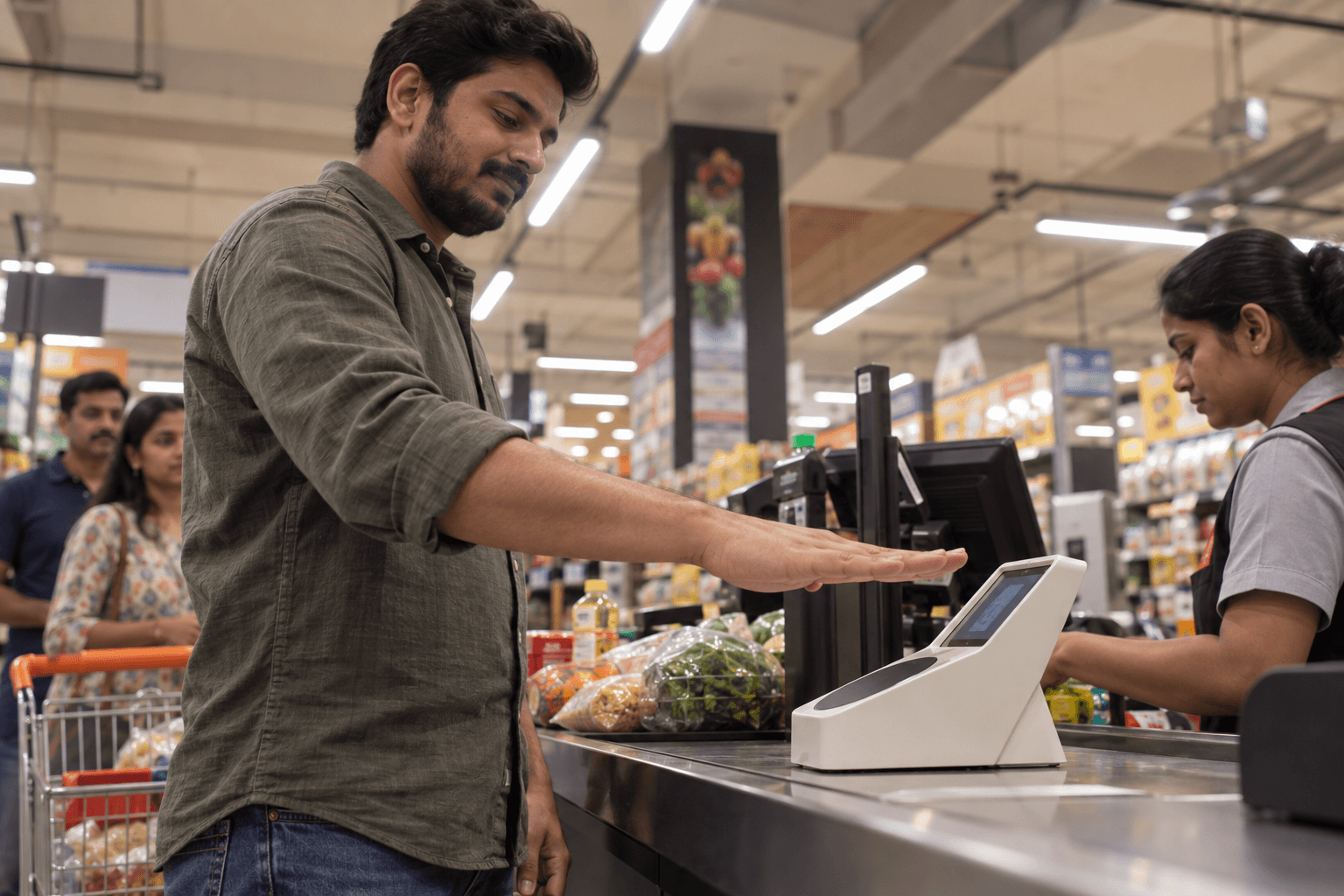
At the counter
One gesture, and the line keeps moving.
Time at the reader is the whole product. The customer hovers, the terminal decides on the spot, and the POS receives an approval, so the queue never waits on someone finding an app or a cashier re-reading a QR code.
- 5-15 cm contactless hover, +/-25 deg rotation tolerance
- Sub-2 second target for the complete payment cycle
- No shared touch surface at the counter
- Falls back to UPI QR or card without abandoning the sale
Integration surface
It attaches to the rail you already run.
PalmPay just proves who the customer is. The actual payment still runs through your existing bank/UPI setup.
| Payment rail | UPI switchA verified palm authorizes the collect request. Money movement stays on the rail you already settle on. |
|---|---|
| POS integration | Terminal SDK, Linux / Android / WindowsThe POS receives an approval event. No change to your item scanning, pricing or receipt flow. |
| Counter footprint | Reader at the customer edge, edge unit belowNo cradle, no guide rail and no change to the lane layout. Contactless at 5-15 cm. |
What the POS receives
- Match result
- 1:N, store roster
- Liveness
- Blood flow confirmed
- Authorization
- Single-use token
- Terminal
- Lane identifier
- Latency
- Measured, per event
Fallback ladder
01
Re-present the palm
The LED halo indicates the angle. Rotation tolerance is +/-25 deg, so a second attempt is usually immediate.
02
UPI QR or card
The same terminal falls back to your existing tender types without abandoning the sale in progress.
03
Cashier override
Recorded against the lane and the shift, so the exception is auditable rather than invisible.
Line busting
A lane runs at the speed of its slowest step.
In most Indian retail queues the slowest step is not scanning the basket. It is the customer unlocking a phone, finding an app, waiting for a network, reading a code and typing a PIN. Removing that step is worth more at peak than any change to the till.
40+/min
verifications per lane at peak
sub-2s
complete payment cycle, target
0
devices the customer has to carry
13.9B
monthly UPI transactions this rides on
Where it lands first
| QSR | Peak-hour queue length is the constraintOrder and pay resolve in one gesture at the till. The reader removes a step instead of adding one. |
|---|---|
| Supermarket | Consistency across every laneEach lane runs the same edge unit and the same template store, so a customer is not lane-dependent. |
| Pharmacy | Assisted, often unhurried, often elderlyNo app to open, no PIN to recall and no card to hand over the counter. |
| Kirana and assisted commerce | One phone per householdPayment does not require the customer to be the person holding the phone the app is installed on. |